One of the more common readings which you will hear in a Unitarian Universalist service is the “Litany of Atonement” by Reverend Robert Eller-Isaacs. It is an acknowledgement of the ways that we have fallen short of our ideals and an invitation to start again. I have always loved this litany. However, recently, I have started to feel like it is incomplete.
— Robert Eller-Isaacs (#637, Singing the Living Tradition)“A Litany of Atonement”
For remaining silent, when a single voice would have made a difference,
We forgive ourselves and each other; we begin again in love.For each time that our fears have made us rigid and inaccessible,
We forgive ourselves and each other; we begin again in love.For each time that we have struck out in anger without just cause,
We forgive ourselves and each other; we begin again in love.For each time our greed has blinded us to the needs of others
We forgive ourselves and each other; we begin again in love.For the selfishness that sets us apart and alone,
We forgive ourselves and each other; we begin again in love.For falling short of the admonitions of the spirit,
We forgive ourselves and each other; we begin again in love.For losing sight of our unity,
We forgive ourselves and each other; we begin again in love.For these and for so many acts, both evident and subtle,
which have fueled the illusion of separateness,
We forgive ourselves and each other; we begin again in love.
There is something missing. I think, it has something to do with making amends. Something to do with justice. An acknowledgement of our past mistakes is good. A commitment to do better in the future is good. But what about trying to make things right in the present?
Eller-Isaacs passed away just last year. But before he died, he acknowledged that, though he did not intend it that way, the litany could actually be read as an evasion of responsibility. When there is a disruption in the collective peace, there is a strong impulse to return to the status quo as soon as possible. Avoiding conflict can be a way of avoiding accountability. Our desire for peace can overwhelm the desire for justice. The result is that those who call out wrongs and those who have opened up about their hurts are effectively silenced. I have seen this happen again and again.
I have seen how the well-intentioned encouragement to forgive and the optimistic urge to move on have been used to silence dissent, avoid confronting uncomfortable truths, and reinforce the status quo. As uplifting as it is to look to the future, if we rush to “begin again in love” without really doing the hard work of change, then the “litany of atonement” becomes a “litany of avoidance”.
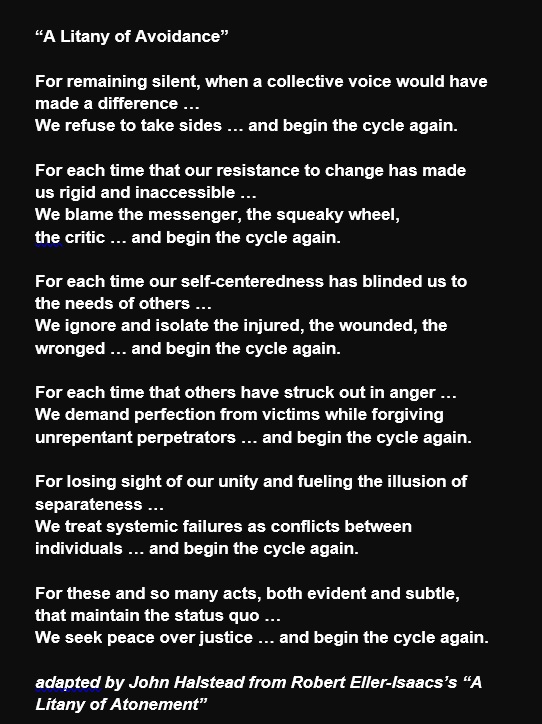
— Adapted by John Halstead from Robert Eller-Isaacs’s “A Litany of Atonement”“A Litany of Avoidance”
For remaining silent, when a collective voice would have made a difference …
We refuse to take sides … and begin the cycle again.For each time that our resistance to change has made us rigid and inaccessible …
We blame the messenger, the squeaky wheel, the critic … and begin the cycle again.For each time our self-centeredness has blinded us to the needs of others …
We ignore and isolate the injured, the wounded, the wronged … and begin the cycle again.For each time that others have struck out in anger …
We demand perfection from victims while forgiving unrepentant perpetrators … and begin the cycle again.For losing sight of our unity and fueling the illusion of separateness …
We treat systemic failures as conflicts between individuals … and begin the cycle again.For these and so many acts, both evident and subtle, that maintain the status quo …
We seek peace over justice … and begin the cycle again.
I believe these two litanies should be read together. The first one points us toward the possibility of doing better in the future. But the second one reminds us that, without really doing the work to change our collective habits and systems, then starting over is just an invitation to repeat the mistakes of the past. Without responsibility, there can be no reconciliation. Without accountability, there can be no atonement. Without justice, there can be no true peace.

 The Allergic Pagan